Designing a secure IT infrastructure is critical for businesses seeking to protect digital assets, maintain customer trust, and comply with industry regulations. A robust security framework not only guards against external attacks but also fortifies internal processes, ensuring that every component from network devices to end-user systems operates under the highest standards. The following guidelines outline a structured approach to identifying risks, building a layered architecture, and maintaining continuous oversight.
Risk Assessment and Business Impact Analysis
A thorough risk assessment lays the groundwork for a resilient infrastructure. By systematically evaluating threats, vulnerabilities, and potential impacts on critical operations, organizations can prioritize security efforts and allocate resources effectively.
Identifying Threats and Vulnerabilities
- Conduct regular scans and penetration tests to detect vulnerability points in network devices, applications, and servers.
- Monitor threat intelligence feeds to stay informed about new malware strains, zero-day exploits, and industry-specific attack vectors.
- Engage third-party auditors to perform unbiased reviews of existing controls and configurations.
Business Impact Analysis (BIA)
- Classify data and processes based on their significance to daily operations and revenue generation.
- Estimate potential downtime costs, regulatory fines, and reputational damage for each scenario.
- Define Recovery Time Objectives (RTO) and Recovery Point Objectives (RPO) for critical systems.
Risk Prioritization and Treatment
Once risks are cataloged, rank them by likelihood and potential impact. This enables the creation of tailored mitigation plans, which may include network segmentation, access control enhancements, or incident response drills. Allocate budget for both preventive measures (like firewalls and intrusion detection) and corrective actions (patch management, backups).
Architectural Principles for a Secure Environment
Implementing a defense-in-depth strategy ensures that multiple layers of controls protect sensitive resources. No single security mechanism is foolproof, but combining several techniques can dramatically reduce attack success rates.
Network Segmentation and Isolation
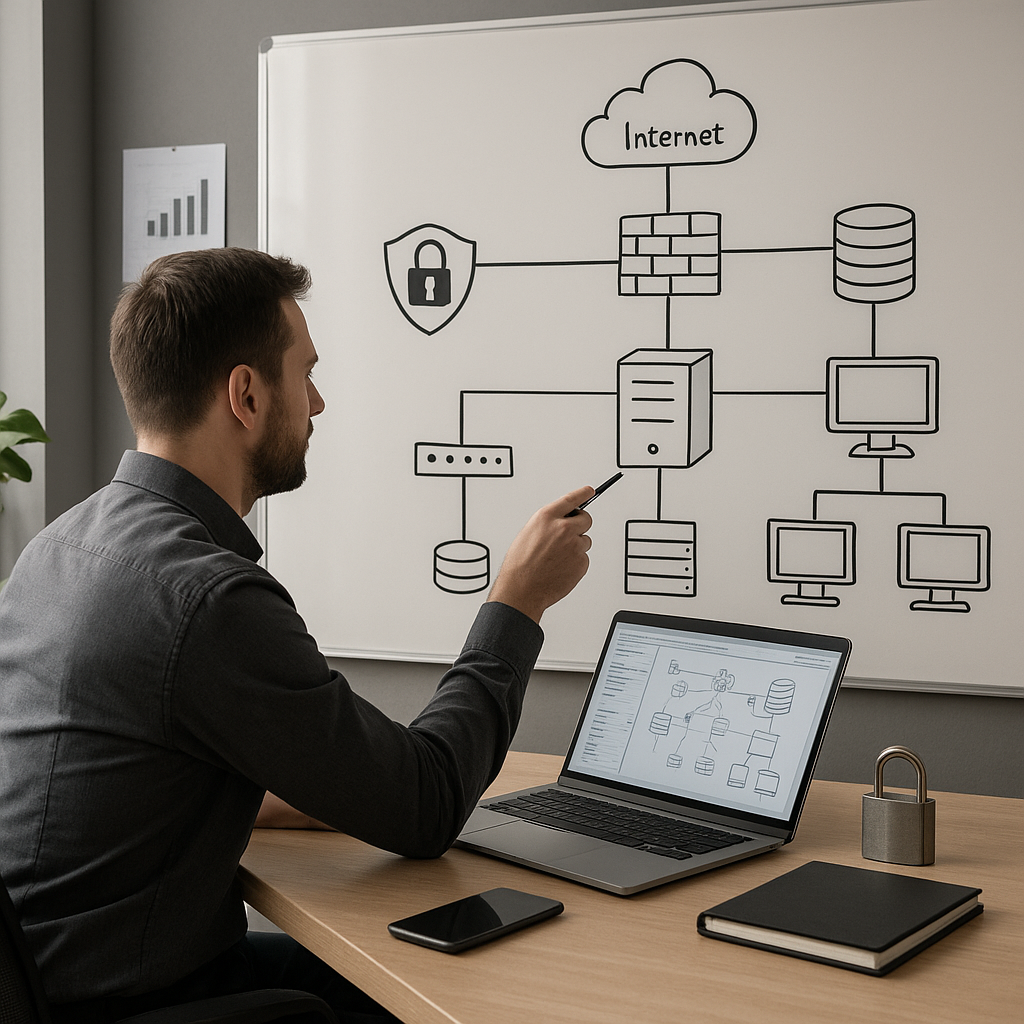
- Divide the network into distinct zones (e.g., DMZ, internal, management) using VLANs and virtual firewalls.
- Restrict east-west traffic between segments; only allow specific services and ports through.
- Use micro-segmentation in virtualized or cloud environments to enforce granular controls at the workload level.
Encryption and Data Protection
Data must remain secure both at rest and in transit. Apply strong encryption algorithms (AES-256, RSA-2048) for:
- Disk and file system encryption on servers and endpoints.
- SSL/TLS for web applications, email, and API communications.
- Database encryption for customer and financial records.
Key management is equally vital. Employ Hardware Security Modules (HSMs) or cloud-based key vaults to store and rotate cryptographic keys.
Strong Authentication and Access Management
- Implement multi-factor authentication (MFA) for all privileged accounts.
- Adopt the principle of least privilege: grant users only the minimum permissions necessary for their roles.
- Use a centralized identity provider (IdP) with single sign-on (SSO) and robust session controls.
Monitoring, Logging, and Threat Detection
Continuous oversight is necessary to detect anomalies and respond to incidents in real time. A Security Information and Event Management (SIEM) solution aggregates logs from servers, firewalls, applications, and endpoints, enabling automated analysis and alerting.
- Define log retention policies to meet compliance standards (GDPR, HIPAA, PCI DSS).
- Implement user and entity behavior analytics (UEBA) to uncover suspicious patterns.
- Integrate endpoint detection and response (EDR) tools for deep visibility into workstation activity.
Implementation, Operations, and Continuous Improvement
An effective security infrastructure requires consistent management, regular updates, and adaptive processes that evolve with emerging threats.
Change Management and Patch Processes
- Maintain an inventory of all hardware and software assets.
- Establish a formal change approval workflow involving security, operations, and business owners.
- Schedule regular patch windows and emergency procedures for critical fixes.
Incident Response and Resilience
Despite best efforts, breaches may occur. An incident response plan ensures a swift and organized reaction:
- Form a cross-functional response team with clearly defined roles.
- Develop playbooks for common scenarios (ransomware, data exfiltration, insider threats).
- Conduct regular tabletop exercises and simulated attacks to test readiness.
- Leverage backups and disaster recovery drills to verify system resilience and adherence to RTO/RPO.
Security Awareness and Training
Human error often triggers security incidents. A comprehensive program should include:
- Onboarding sessions covering password hygiene, phishing recognition, and reporting protocols.
- Periodic newsletters and interactive modules to reinforce best practices.
- Targeted training for high-risk departments (finance, HR, development).
Governance, Risk, and Compliance (GRC)
Align security policies with business objectives and regulatory requirements. Implement a GRC framework to:
- Monitor policy adherence through internal audits and vendor assessments.
- Document risk treatment plans and certification statuses.
- Ensure continuous monitoring of control effectiveness and update policies as standards evolve.
Emerging Technologies and Future-Proofing
Stay ahead of the curve by evaluating innovative solutions:
- Zero Trust architectures that assume no implicit trust within the network perimeter.
- Behavioral biometrics and adaptive authentication to strengthen access controls.
- Artificial intelligence and machine learning for predictive threat analysis.
By integrating these advanced capabilities, organizations can proactively address sophisticated attack methods and maintain an agile, secure IT environment.